
Thinking About Chromium in Late-Lactation Cows
Ruminating on our own research
If you’ve been following this blog from the start, you know I like to chew on research that catches my eye, and share a few nuggets along of the way. Today, though, I’m turning the spotlight inward. Instead of ruminating on someone else’s study, I’m sharing results from research led by the great team I work with at Chemlock Nutrition. This research was shared this past June at the American Dairy Science Association (ADSA) Annual Meeting.
Why chromium matters in dairy nutrition
Chromium’s role in dairy nutrition is well established. It increases insulin sensitivity which then increases glucose uptake by cells. Many studies have already shown improved health and milk production because of this increase in energy. Most of the time, though, the research only evaluated dairy cows during the transition or early lactation periods.
That got us thinking. What happens when you feed Nutrilock® Chromium throughout the entire lactation? With that question in mind, we partnered with a commercial dairy in Wisconsin equipped with robotic milking machines for the duration of this 14-month study.
A tale of two pellets
The setup was straightforward. Cows enrolled in the study were fed a common diet with one key difference. Cows with an even ear tag received pellets in the robotic milkers with Nutrilock® Chromium, and cows with odd ear tags were given pellets with no supplemental chromium. They were the control group.
Cows began on their respective control or treatment pellet about 21 days prior to calving and continued through late lactation.
Milk production was tracked weekly and analyzed in groups. The first group was cows that were 1-14 DIM and the remaining groups were 30-day intervals from 15-254 DIM. Here’s what stood out:
The results: Milk that keeps on coming

Milk yield was significantly higher in supplemented cows at multiple time points.
Cows supplemented with Nutrilock® Chromium showed an increase of:
- 6.0 lbs in Group 90, which included cows between 75-104 DIM
- 8.3 lbs in Group 120, which was cows between 105-134 DIM
- 7.1 lbs in Group 150, which included cows between 135-164 DIM
There was also a tendency (P = 0.06) for higher milk production in the Nutrilock® Chromium treatment cows in Group 1, which was cows from 1-14 DIM.
Overall, there was an average 4.0 lb/h/d increase in milk yield in cows supplemented with Nutrilock® Chromium over cows not supplemented.
TL;DR: Nutrilock® Chromium boosts milk yield beyond early lactation
Cows fed Nutrilock® Chromium didn’t just get off to a strong start – they kept going. On average, they produced 4 lbs more milk per day from 1 to 254 DIM compared to cows that didn’t get chromium. And the boost wasn’t just early on. The biggest gains showed up between 105 to 164 DIM, proving that the benefits of Nutrilock® Chromium extend well past early lactation.
Dairy economics: Nutrilock® Chromium delivers ROI
You might be wondering what this means in the real world. Is supplementing Nutrilock® Chromium an attractive proposition to dairy producers large and small?
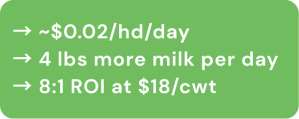
The math checks out. At a cost of about $0.02/head/day and a milk increase of 4 lbs/head/day, you’re looking at an 8:1 ROI at $18/cwt milk. That’s a strong value proposition!
Keep ruminating (and digging into the data)
This trial reminds us that sometimes the biggest opportunities aren’t in developing something brand new. Instead, they can be found in rethinking how we use the tools we already have. Nutrilock® Chromium has long been valued for its transition cow benefits, but this research shows it delivers well into late lactation.
If you’re a dairy nutritionist looking to drive consistent performance without reinventing the ration, Nutrilock® Chromium deserves a closer look.
Want to see the full data for yourself?
Author: Rick Brown is Chemlock Nutrition’s Dairy Science Director with a BS in Animal Science from Cornell University.